

Webinar recording
Choosing the right Energy Dispersive Spectroscopy (EDS) system is critical for accurate material analysis in scanning electron microscopy (SEM). In this webinar, we will guide you through key factors to consider when selecting an EDS system, including performance, resolution, detection limits, and application-specific requirements.
The video loads from YouTube when you select the button. YouTube processes data related to playback.
Open on YouTube ↗- Year
- 2026
- Duration
- 1 h 3 min 23 s
Webinar description
Description
Choosing the right Energy Dispersive Spectroscopy (EDS) system is critical for accurate material analysis in scanning electron microscopy (SEM). In this webinar, we will guide you through key factors to consider when selecting an EDS system, including performance, resolution, detection limits, and application-specific requirements.
01:20 – EDS System Selection & Detector Fundamentals Introduction to selecting an Energy Dispersive Spectroscopy (EDS) system, focusing on hardware requirements and application needs. The speaker discusses detector efficiency, size, and integration with scanning electron microscopes (SEM), along with the evolution from traditional detectors to modern silicon drift detectors (SDDs).
Key detector parameters such as energy resolution and solid angle are introduced.
12:53 – Flat Detector Geometry & Beam-Sensitive Samples Explanation of how flat detector configurations improve X-ray collection, particularly when using low electron beam currents. The segment covers challenges in analyzing beam-sensitive materials such as biological samples and polymers, and explains how lower accelerating voltage can improve spatial resolution and light-element detection.
Monte Carlo simulations are introduced for modeling beam voltage, interaction volume, and analysis depth.
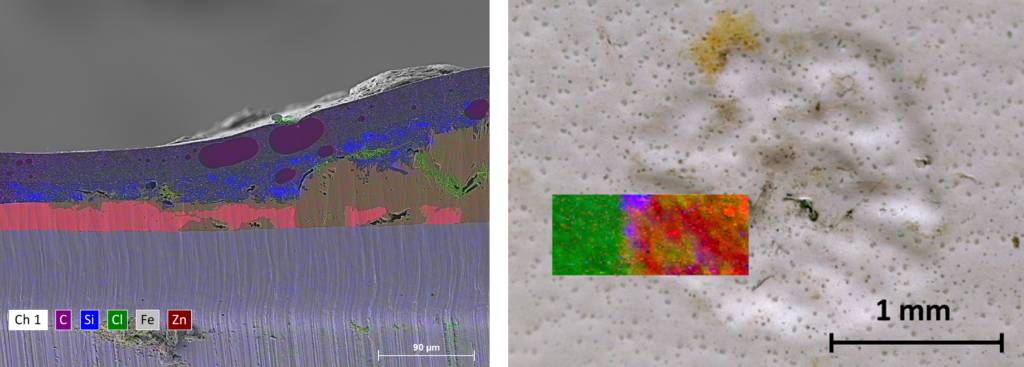
25:01 – Nanoscale Analysis of Metal Oxide Layers A case study demonstrating how high-resolution electron microscopy is used to analyze metal oxide layers. The discussion highlights the role of silicon oxide layers and cavities in determining bonding quality and material performance. The section also covers nanoscale compositional analysis and the influence of detector window materials on noise reduction and spectral resolution.
37:16 – Low-Energy X-Ray Detection & Detector Design Choices Focus on selecting detectors for low-energy X-ray analysis. The speaker explains the advantages and limitations of windowless detectors, including sensitivity challenges and cost. Additional considerations include detector size, solid angle benefits, mapping speed, and how detector performance affects trace element detection.
49:45 – Data Processing, Spectrum Quality & Detector Lifespan Discussion of data processing considerations in EDS analysis, including dead time, processing speed, and background subtraction. The speaker explains how processing time influences energy resolution and detection accuracy, and concludes with considerations around detector wear and resolution degradation caused by prolonged X-ray exposure.
Webinar chapters
Timestamps from the video description. Selecting a link loads the YouTube player at that point.