

Sample Preparation and Material Testing Methods
Top Analytica provides professional sample preparation and material treatment services for microscopy, surface analysis and materials research. We prepare samples for cross-sectional analysis and can also perform mechanical, chemical and environmental treatments before analysis.
The appropriate preparation method depends on the material, structure and analytical objective. Our sample preparation services include Broad Ion Beam (BIB) milling, mechanical polishing and microtomy. We also provide selected sample treatments, coating preparation, QUV weathering and colour measurements.
Sample preparation for materials analysis
Sample preparation is often a critical step in materials characterization. A suitable cross-section or surface preparation can reveal interfaces, coating layers, defects, inclusions and other features that cannot be investigated reliably from the original sample surface.
Broad Ion Beam (BIB) cross-sectioning
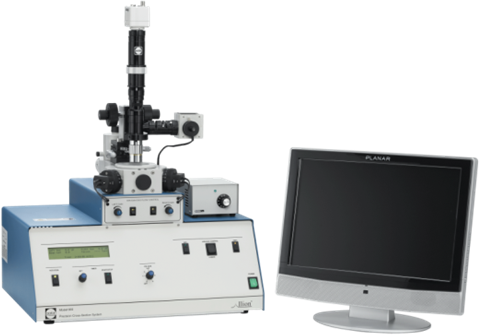
Broad Ion Beam (BIB) milling is a high-quality method for preparing cross-sections of materials and multilayer structures. Accelerated ions, typically argon ions, remove material by sputtering. Because material is removed without conventional mechanical cutting forces, BIB can produce a clean and relatively undisturbed cross-section surface.
A mask can be used to define the milling area and produce a planar cross-section. BIB preparation is particularly useful when interfaces, thin layers, coatings, particles or other small-scale features need to be examined by microscopy or surface analysis.
When is BIB cross-sectioning useful?
- Cross-sectional analysis of coatings and multilayer structures
- Investigation of interfaces and thin layers
- Preparation of samples for SEM and EDS analysis
- Investigation of defects, inclusions and local features
- Materials where mechanical preparation may damage or deform the area of interest
Mechanical polishing
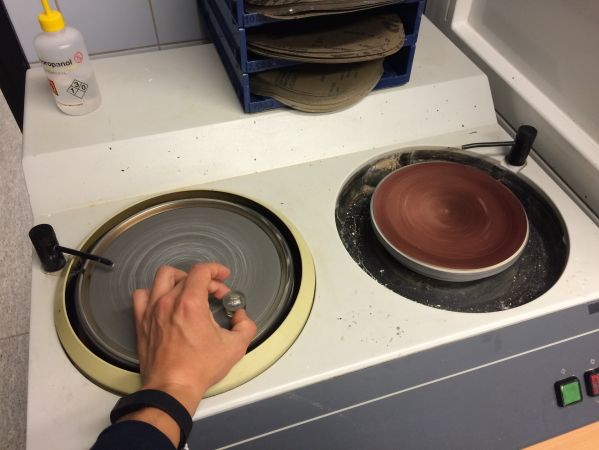
Mechanical polishing is a conventional method for preparing cross-sections and polished material surfaces. Samples can be embedded in epoxy when required, or polished directly when the sample geometry and material allow it.
Depending on the material and required surface quality, silicon carbide and diamond abrasives can be used in successive preparation steps.
Microtomy
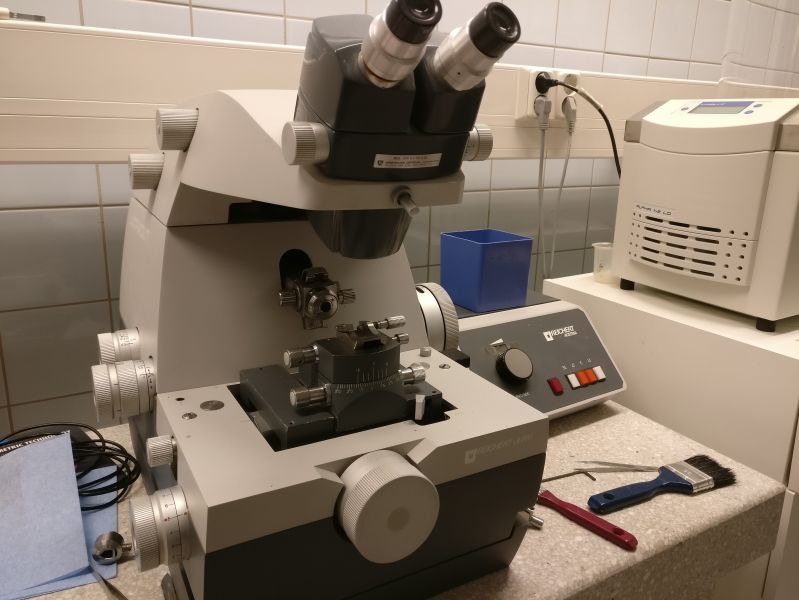
Microtomy is a sample preparation technique in which thin sections are produced using a sharp knife. Depending on the material and application, glass or diamond knives can be used.
Microtomy can be useful when thin sections are required for microscopic examination or when a material needs to be sectioned with minimal sample dimensions.
Sample treatments and material testing
In addition to physical sample preparation, Top Analytica can perform selected treatments and testing procedures to investigate how materials, coatings and surfaces respond to environmental or chemical exposure.
QUV accelerated weathering
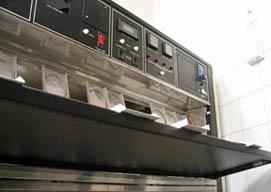
QUV testing is an accelerated weathering method in which samples are exposed to ultraviolet radiation and moisture. The test can be used to investigate changes in materials and coatings caused by simulated environmental exposure.
QUV testing can be combined with other measurements to investigate changes in appearance, surface properties, coating performance or material structure before and after exposure.
Chemical treatments
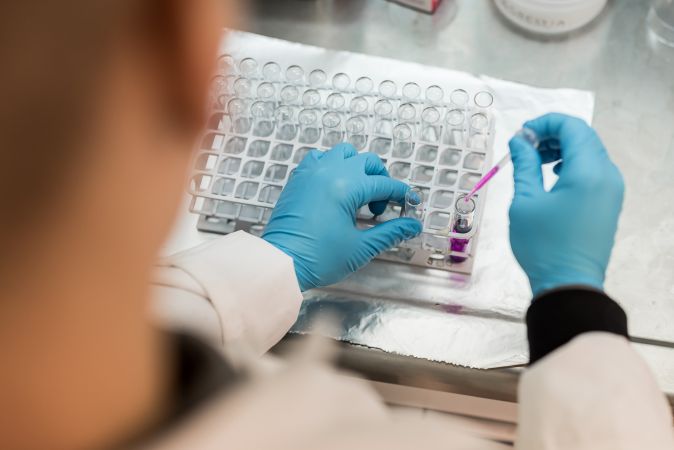
Samples can be subjected to selected chemical treatments when chemical exposure is relevant to the research question. Depending on the project, treatments may include acidic exposure or corrosion-related testing.
- Acidic treatments
- Corrosion exposure
- Other project-specific chemical treatments
Paint coating preparation
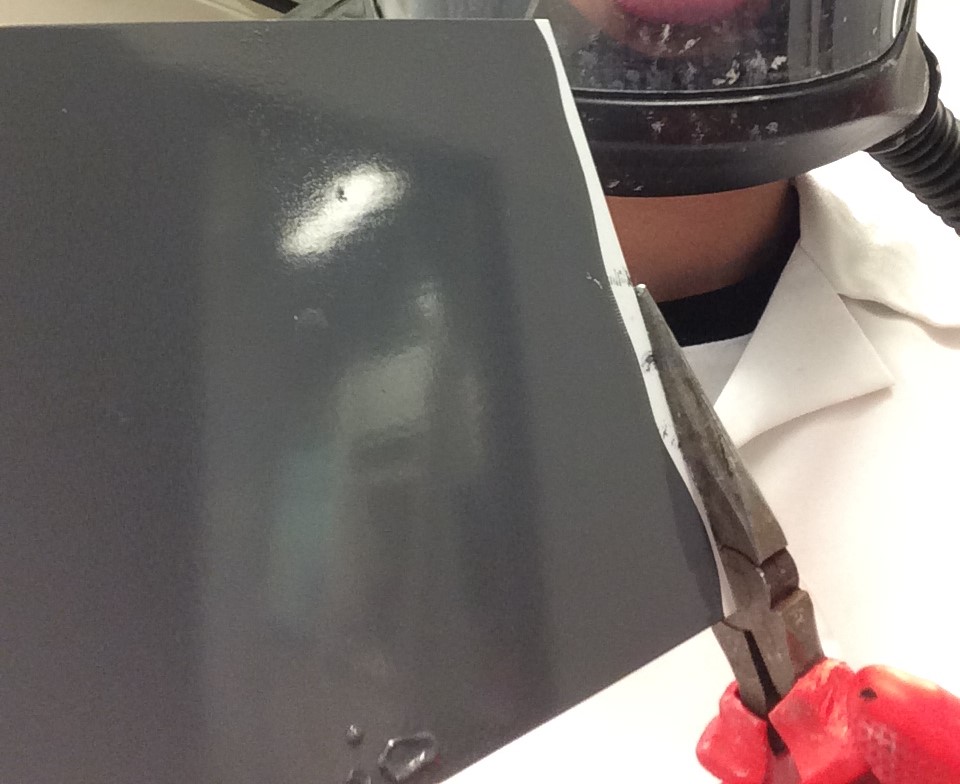
Top Analytica can prepare painted metal samples for materials research, coating studies and performance testing. Samples can be washed and pre-treated before applying multilayer paint coatings to metal sheets.
Coatings can be applied to a controlled layer thickness and cured by heating. The appropriate curing conditions can be investigated as part of the project.
This type of controlled sample preparation can be used when comparing coating formulations, investigating coating performance or preparing samples for subsequent surface and materials analysis.
Colour measurement
Colour measurement can be used to quantify differences in the appearance of materials and coatings before and after treatment or between different samples and batches.
How is colour measured?
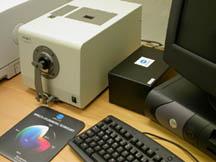
The Konica Minolta CM-3600d spectrophotometer measures colour in the visible wavelength range of 360–740 nm. Suitable samples include solid and flat samples, powders, crystals and liquids. Liquid samples are measured using transmittance measurement.
The instrument uses controlled illumination and detects light reflected from the sample. Colour can be described using the CIE L*a*b* colour space, where L* represents lightness, a* represents the green–red axis and b* represents the blue–yellow axis.
- CIE L*a*b* colour space
- Visible range: 360–740 nm
- Illuminant D65
- Measuring geometry D/8
- 10° observer
- Measurements with and without gloss
- Three measuring openings
How do you choose the right sample preparation method?
The most suitable preparation method depends on the sample material, geometry, structure and analytical objective. For example, a cross-section intended for SEM/EDS analysis may require a different preparation strategy from a sample intended for optical microscopy or surface-sensitive analysis.
| Research need | Possible approach |
|---|---|
| High-quality cross-section | Broad Ion Beam (BIB) milling |
| Conventional cross-section preparation | Mechanical polishing |
| Thin sections | Microtomy |
| Environmental exposure | QUV weathering |
| Chemical exposure | Project-specific chemical treatment |
| Controlled coating preparation | Paint coating preparation |
| Colour differences | Spectrophotometric colour measurement |
Sample preparation for SEM, surface analysis and materials research
Sample preparation is often combined with microscopy and materials characterization. Depending on the research question, prepared samples can be investigated using techniques such as SEM/EDS, XPS, ToF-SIMS, Raman spectroscopy and other analytical methods.
For example, a coating cross-section prepared using BIB milling can subsequently be investigated using SEM/EDS to examine coating layers, interfaces and local elemental composition. Top Analytica has also used BIB-prepared cross-sections together with SEM/EDS and Raman spectroscopy to investigate coating failure and corrosion-related phenomena.
Need help choosing a sample preparation method?
Tell us what your sample is made of, what you need to investigate and which analytical technique you are considering. We can help determine a suitable sample preparation strategy and discuss the most appropriate analysis method for your research question.