

Colour, Gloss and pH Measurement Services
Top Analytica provides laboratory measurements of colour, surface gloss and pH for materials, coatings and other samples. These measurements can be used to compare samples, characterise material properties, investigate differences between batches and support materials and surface analysis.
Our optical and chemical measurements can also be combined with other analytical methods, such as microscopy, SEM-EDS, XPS, ToF-SIMS and Raman spectroscopy, when a more detailed investigation of a material or surface is required.
Colour Measurement
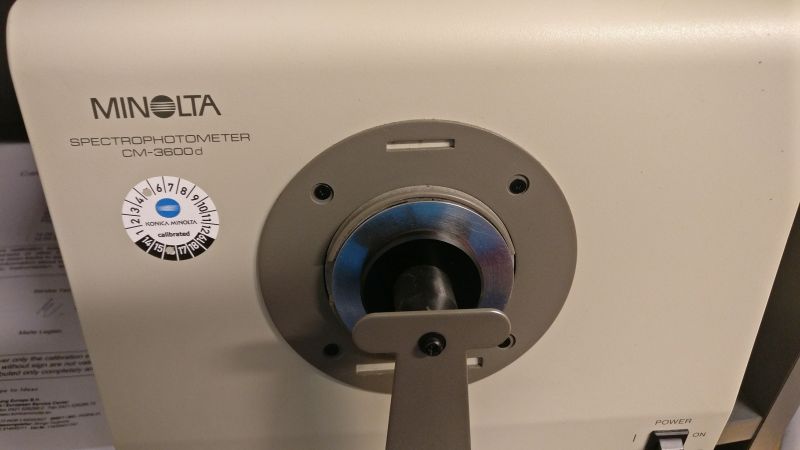
Spectrophotometric colour measurement provides an objective and quantitative way to characterise the colour of a material. Top Analytica uses a Konica Minolta CM-3600d spectrophotometer for colour measurements in the visible wavelength range of 360–740 nm.
The colour of a sample can be expressed using the CIE L*a*b* colour space. In this system, L* describes lightness, while a* represents the green–red axis and b* the blue–yellow axis. Colour differences between samples can therefore be quantified rather than assessed only by visual comparison.
What samples can be measured?
Depending on the sample and measurement configuration, colour measurements can be performed on solid, flat, powder, crystal and liquid samples. Liquid samples are measured using a transmittance measurement.
Colour measurement specifications
- Colour scale: CIE L*a*b*
- Wavelength range: 360–740 nm
- Primary illuminant: D65
- Measurement geometry: D/8
- Observer: 10°
- Measurements: with and without gloss
- Measuring openings: three available sizes
Applications of colour measurement
Quantitative colour measurement can be useful when comparing materials or investigating changes in appearance. Applications may include comparison of material batches, coating and surface treatment evaluation, colour difference measurements and investigation of changes caused by processing or other treatments.
Gloss Measurement
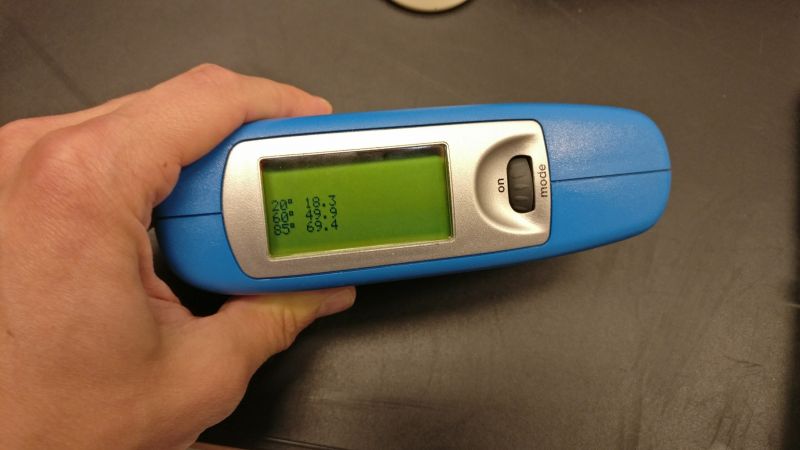
Surface gloss measurement provides a quantitative measurement of the specular reflection from a material surface. Gloss can be used to compare surfaces and evaluate differences resulting from coatings, surface treatments, processing or material properties.
Top Analytica uses a portable ERICHSEN PICOGLOSS 503 three-angle gloss meter. Gloss can be measured simultaneously at 20°, 60° and 85°, allowing surfaces with different gloss levels to be characterised.
Gloss measurement angles
- 20°: suitable for high-gloss surfaces
- 60°: general-purpose geometry for medium-gloss surfaces
- 85°: suitable for low-gloss or matte surfaces
Gloss measurements are reported in gloss units (GU) and can be used to quantify differences in surface appearance between samples.
pH Measurement
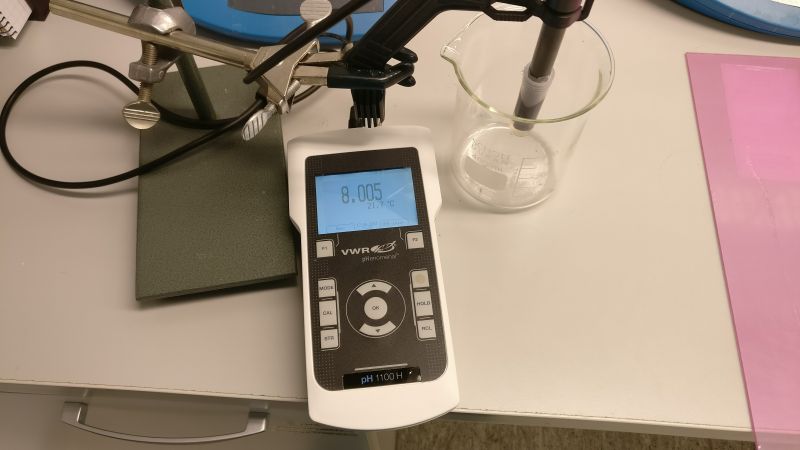
pH measurement is used to determine the acidity or alkalinity of aqueous samples. pH measurement can be used as part of material and sample characterisation when the chemical environment or acidity of a sample is relevant to the investigation.
Which measurement is suitable for my sample?
| What you want to determine | Suitable measurement |
|---|---|
| Colour of a material | Spectrophotometric colour measurement |
| Lightness and colour coordinates | CIE L*a*b* colour measurement |
| Colour difference between samples | Colour measurement and colour-difference analysis |
| Surface gloss | Gloss measurement |
| Differences in gloss between surfaces | Multi-angle gloss measurement |
| Acidity or alkalinity of an aqueous sample | pH measurement |
Combining optical measurements with materials analysis
A difference in colour, gloss or another measured property can sometimes indicate a change in the composition, structure or surface of a material. When further investigation is required, optical measurements can be combined with other analytical techniques available at Top Analytica.
Depending on the material and research question, complementary techniques may include scanning electron microscopy (SEM), energy-dispersive X-ray spectroscopy (EDS), X-ray photoelectron spectroscopy (XPS), time-of-flight secondary ion mass spectrometry (ToF-SIMS) and Raman spectroscopy.
Do you need colour, gloss or pH measurement?
Tell us about your sample and what you need to determine. We can help identify a suitable measurement approach and discuss whether additional materials or surface analysis would be useful.